
A C4I Integrated Control Center for Mega Events is the technical foundation for safe, coordinated, and resilient mega-event operations. By unifying communications, intelligence, and real-time monitoring, it enables multiple stakeholders to act with speed and clarity. However, the modern operational environment demands an evolution: moving beyond isolated monitoring toward an Adaptive Resilience Center. This integrated approach ensures organizers can maintain situational awareness, strengthen proactive incident response, and sustain mission-critical continuity throughout the entire event lifecycle.

What Is a C4I Integrated Control Center for Mega Events?
A C4I Integrated Control Center for Mega Events is a centralized operational environment that integrates command, control, communications, computers, and intelligence into a single unified platform. It enables multiple agencies and stakeholders to monitor, coordinate, and respond to dynamic situations in real time.
These control centers are designed to manage the complexity of large-scale events such as international sports tournaments, national celebrations, and global exhibitions. By consolidating data from surveillance systems, communication networks, and operational platforms, they provide a comprehensive, real-time view of ongoing activities and potential risks.
An integrated command and control center ensures that decision-makers have immediate access to accurate and actionable information. This allows for faster response times, improved coordination between security forces, emergency services, and event organizers, and a significant reduction in operational silos.
Ultimately, the goal of a C4I control center is to maintain situational awareness, support proactive decision-making, and ensure the safety, security, and operational success of the event from planning through execution.
Why Mega Events Require Advanced Control Centers
Mega events bring together large crowds, multiple stakeholders, and complex operations that must function seamlessly under tight timelines. Without a centralized system, managing security, logistics, communications, and emergency response becomes fragmented and inefficient.
A C4I Integrated Control Center for Mega Events addresses these challenges by providing a unified operational environment where all critical functions are monitored and coordinated in real time.
An integrated command and control center enables proactive monitoring, early detection of potential issues, and coordinated responses across all involved agencies.
In addition, effective mega event control center design ensures that workflows, technologies, and teams are aligned, improving efficiency and reducing operational risks.
C4I System Architecture for Mega Events
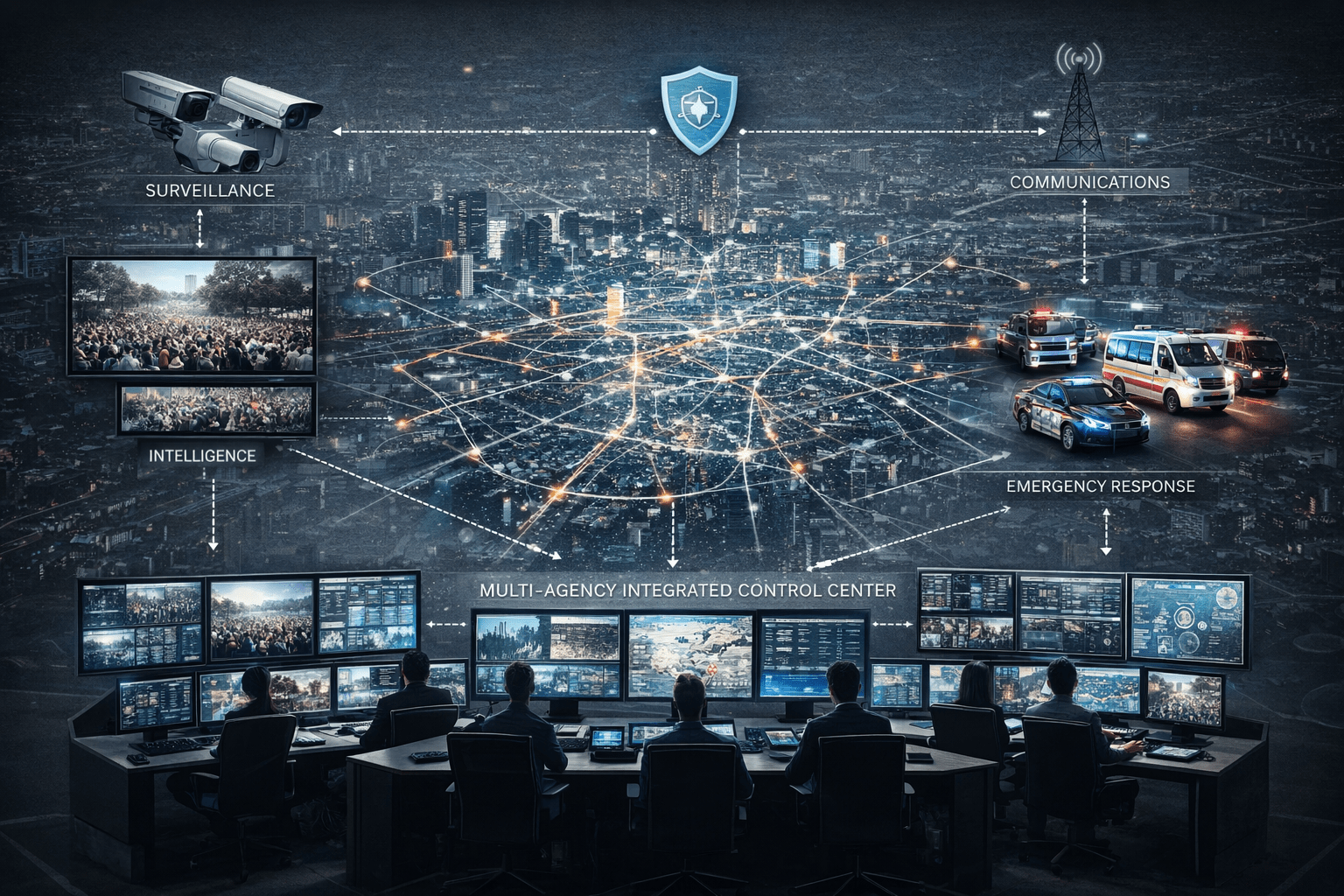
A successful C4I Integrated Control Center for Mega Events depends on a clear and scalable system architecture that connects people, processes, and technology.
Data sources such as CCTV, sensors, communication systems, and operational tools feed into a unified environment, providing a consolidated view of event activities.
An integrated command and control center ensures seamless integration of all systems, enabling real-time monitoring and coordinated responses.
Technology Integration and Resilience
Technology enables control, but it does not create it. A C4I environment integrates systems such as video management, access control, building management, public address, GIS, and incident management platforms into a unified operational framework.
Integration must be designed around operational priorities, including alarm logic, escalation pathways, and system health monitoring. This ensures that information flows seamlessly and supports real-time decision-making.
Manual fallback procedures must also exist for critical functions in case of system failure. Technical documentation such as architecture diagrams, integration matrices, and system operating procedures supports maintenance, audits, and reliable upgrades without disrupting operations.
The architecture also includes decision-support tools, dashboards, and workflows that help operators act quickly and effectively during critical situations.
Planning for C4I readiness milestones ensures that every layer is tested and operational before live deployment.
Beyond C4I: The Evolution Toward Adaptive Resilience
As mega events, smart cities, and critical infrastructure environments become increasingly interconnected, traditional command-and-control models are no longer sufficient. Modern operational environments require more than monitoring capabilities — they require adaptive resilience.
C4I platforms provide the operational foundation for this evolution by integrating communications, intelligence, operational coordination, and real-time situational awareness into a unified decision-making environment. The objective is no longer limited to incident response alone. It is the creation of resilient operations capable of anticipating disruption, adapting dynamically, and maintaining continuity under rapidly changing conditions.
Today’s Resilience Centers are designed to unify multi-agency operations, support proactive risk management, and enable coordinated response across security, transportation, public safety, health, event operations, and emergency management functions.
From Fragmented Oversight to Integrated Coordination
Traditional operations environments often operate in silos, where security teams, transportation operators, emergency responders, health services, and event stakeholders maintain separate systems, communication channels, and decision-making structures. This fragmentation limits situational awareness, delays response times, and increases operational risk during high-pressure situations.
Modern C4I-enabled Resilience Centers eliminate these barriers by creating a unified operational ecosystem built around a common operating picture and shared decision-making framework. Through integrated coordination, stakeholders gain real-time visibility across all operational domains, enabling faster escalation, synchronized response actions, and improved operational continuity.
This evolution establishes a true Unity of Command — where agencies and operational stakeholders remain functionally independent while operating through aligned governance, shared intelligence, and coordinated operational workflows.
For mega events and complex urban environments, integrated coordination is no longer optional. It is essential for operational resilience.
Proactive Intelligence: Moving "Left of Bang"
Operational resilience depends on the ability to identify emerging risks before they escalate into operational disruption or crisis events. Modern Resilience Centers therefore shift from reactive incident management toward proactive intelligence-led operations.
This approach is often described as moving “Left of Bang” — identifying indicators, anomalies, vulnerabilities, and threat patterns before an incident occurs. By combining intelligence analysis, real-time monitoring, predictive analytics, operational reporting, and cross-agency information sharing, organizations can detect early warning signals and initiate preventative actions before operational impact is realized.
Proactive operations support:
- Early risk identification and mitigation
- Faster operational decision-making
- Improved crisis prevention capabilities
- Enhanced public safety and operational continuity
- Reduced response and recovery time
In modern operational environments, resilience is not measured solely by how effectively organizations respond to incidents. It is measured by how effectively they prevent disruption from occurring in the first place.
The 4 Pillars of Operational Resilience

- Adaptive: Enables real-time operational adjustment, dynamic procedure execution, and flexible response to evolving situations and operational demands.
- Integrated: Unifies data, systems, communications, and operational visibility across all agencies and stakeholders within a common operating environment.
- Proactive: Uses intelligence-led operations, predictive analysis, and continuous risk sensing to identify threats and vulnerabilities before escalation.
- Coordinated: Establishes shared governance, aligned escalation protocols, and synchronized multi-agency decision-making during routine and crisis operations.
Together, these four pillars form the operational foundation of modern Resilience Centers — enabling organizations to maintain continuity, improve agility, strengthen public safety, and support mission-critical operations in increasingly complex environments.
The Golden Thread: Bridging Tech and Strategy
Establishing a resilient operational environment requires more than just deploying state-of-the-art systems; it requires a structured journey toward Operational Maturity. While the C4I architecture provides the necessary digital backbone, the following framework serves as the 'Golden Thread' that connects technical capability to strategic outcomes. By aligning governance, people, and processes through these six critical phases, a control center evolves from a reactive monitoring hub into a proactive Resilience Center, ensuring mission-critical continuity from the first day of planning through the legacy phase of the event.
C4I Readiness Framework for Mega Events
Delivering a successful C4I Integrated Control Center for Mega Events requires more than deploying systems and defining procedures. It demands a structured readiness framework that aligns governance, operations, technology, and people into one coordinated capability.
This framework ensures that all elements of the control center are developed, tested, and validated in a logical sequence. It provides clarity on priorities, reduces integration risks, and supports consistent progress toward operational readiness.
A typical C4I readiness approach includes several core dimensions:
- Governance and command structure – defining authority, decision-making, and escalation
- Operational model – establishing workflows, roles, and coordination mechanisms
- Technology and system integration – ensuring all platforms support real-time operations
- Incident management – standardizing how events are detected, classified, and managed
- Training and exercises – preparing teams to operate effectively under pressure
- Validation and readiness assurance – confirming that systems and teams perform as expected
These elements are not delivered in isolation. They must evolve together through clearly defined C4I readiness milestones, ensuring that the control center is not only technically complete but operationally effective.
The following section outlines a practical milestone-based roadmap that translates this framework into actionable steps across the event lifecycle.
C4I Readiness Milestone List for Mega Events
This milestone-based roadmap helps organizations plan, validate, and mature a C4I Integrated Control Center for Mega Events over time. It provides a practical structure for governance, coordination, incident management, training, and operational readiness across the event lifecycle.
Phase 1 – First Month: Understand, assess, and stabilize the foundation
Milestone 1: Clarify mandate and governance
Confirm how the C4I function fits into the overall event program structure.
Key tasks:
- Identify reporting lines and decision authority
- Define relationships with Security, Safety, Operations, IT, Transport, Medical, and Government agencies
- Establish escalation authority and decision levels
- Map all operational stakeholders
Deliverables:
- C4I governance and authority framework
- Stakeholder map and interface matrix
- Decision and escalation hierarchy
Success indicator:
- Senior leadership and operational departments understand the role of C4I.
Validation questions:
- Do we clearly understand who is in charge during an incident?
- Are all agencies aligned on how incidents will be handled?
- How will information reach decision-makers?
Milestone 2: Assess the operational environment
Understand the current maturity of the operational coordination environment.
Key tasks:
- Review existing operational plans, security plans, emergency response plans, and event concepts
- Assess the command center concept and supporting systems
- Identify operational coordination gaps
Deliverables:
- C4I operational capability assessment
- Gap analysis
- Risk and dependency log
Success indicator:
- Leadership has a clear view of operational readiness and deficiencies.
Validation questions:
- What are the biggest operational risks to the event?
- If a major incident happens tomorrow, what would fail first?
- What keeps you awake at night?
Milestone 3: Define the C4I operating concept
Translate program objectives into a functional model for command and coordination.
Key tasks:
- Define the purpose of the C4I function during routine and incident operations
- Define command relationships during normal operations, elevated operations, and crisis
- Define information flow and decision-support structure
Deliverables:
- C4I Concept of Operations (ConOps)
- Escalation principles
- Coordination model
Success indicator:
- A shared operational concept is approved across stakeholders.
Validation questions:
- Do we clearly understand who is in charge during an incident?
- How will information reach decision-makers?
- Do we have reliable situational awareness?
Phase 2 – Second Month: Design the operational framework
Milestone 4: Command and coordination structure
Formalize how decisions and coordination will occur.
Key tasks:
- Define the operational command hierarchy
- Define incident command integration with authorities
- Define operational coordination procedures
Deliverables:
- Command and coordination framework
- Multi-agency coordination model
- Operational escalation matrix
Success indicator:
- All departments understand when and how C4I assumes coordination leadership.
Validation questions:
- Do we clearly understand who is in charge during an incident?
- Are all agencies aligned on how incidents will be handled?
Milestone 5: Information and intelligence structure
Ensure decision-makers receive structured situational awareness.
Key tasks:
- Define sources of operational information
- Establish the reporting structure
- Define situation reporting and intelligence products
Deliverables:
- Situational awareness model
- Intelligence and reporting framework
- Situation report (SITREP) templates
Success indicator:
- Reliable information flow to leadership and operations.
Validation questions:
- Do we have reliable situational awareness?
- How will information reach decision-makers?
Milestone 6: Incident management framework
Define how incidents will be detected, classified, escalated, and coordinated.
Key tasks:
- Define incident categories and severity levels
- Define response ownership and support functions
- Define coordination procedures
Deliverables:
- Incident classification matrix
- Incident lifecycle framework
- Response coordination model
Success indicator:
- Consistent and structured incident handling across the program.
Validation questions:
- Do we clearly understand who is in charge during an incident?
- Are all agencies aligned on how incidents will be handled?
- What are the biggest operational risks to the event?
Phase 3 – Third Month: Move toward operational readiness
Milestone 7: Operational readiness roadmap
Translate findings into a structured readiness plan.
Key tasks:
- Define operational milestones
- Align with construction, technology, and event timelines
- Identify critical dependencies
Deliverables:
- C4I readiness roadmap
- Milestone tracker
- Critical dependency list
Success indicator:
- Leadership has a clear roadmap to operational readiness.
Validation questions:
- How confident are we that the organization will be operationally ready?
- What keeps you awake at night?
Milestone 8: Training and exercise framework
Prepare stakeholders for coordinated operations.
Key tasks:
- Identify training requirements
- Design multi-agency exercises
- Validate command and coordination processes
Deliverables:
- Training plan
- Exercise program
- Scenario library
Success indicator:
- Operational teams begin validating coordination procedures.
Validation questions:
- How will we test readiness before opening?
- If a major incident happened tomorrow, what would fail first?
Milestone 9: Operational reporting and decision support
Ensure leadership receives structured operational oversight.
Key tasks:
- Define operational KPIs
- Establish an executive reporting structure
- Implement readiness monitoring
Deliverables:
- Operational dashboard concept
- Reporting framework
- Readiness monitoring structure
Success indicator:
- Leadership receives clear, structured operational insights.
Validation questions:
- How will information reach decision-makers?
- Do we have reliable situational awareness?
- How confident are we that the organization will be operationally ready?
Phase 4 – Months 4 to 6: System integration and validation
At this stage, the focus shifts from planning to validation.
Key objectives:
- Support commissioning of the command center environment
- Validate information flows and coordination structures
- Run exercises and simulations
- Close operational gaps
Expected outcomes:
- Tested incident coordination framework
- Confirmed decision-making hierarchy
- Verified multi-agency coordination
Validation questions:
- Are all agencies aligned on how incidents will be handled?
- Do we have reliable situational awareness?
- If a major incident happened tomorrow, what would fail first?
Phase 5 – Months 6 to 12: Operational maturity
This phase focuses on review, improvement, and sustained readiness.
Key objectives:
- Support test events and operational trials
- Refine procedures and coordination workflows
- Implement lessons learned
- Establish stable operational reporting
Expected outcomes:
- Mature coordination processes
- Stable operational governance
- Reliable situational awareness capability
Validation questions:
- How confident are we that the organization will be operationally ready?
- Do we clearly understand who is in charge during an incident?
- Do we have reliable situational awareness?
Mega Event Control Center Design Best Practices
Effective mega event control center design ensures that systems, workflows, and teams operate seamlessly.
The layout should support visibility, communication, and efficient coordination between operators.
An integrated command and control center must unify all systems into a single operational view.
Scalability and flexibility are essential to adapt to evolving event requirements.
Real-Time Situational Awareness and Decision-Making
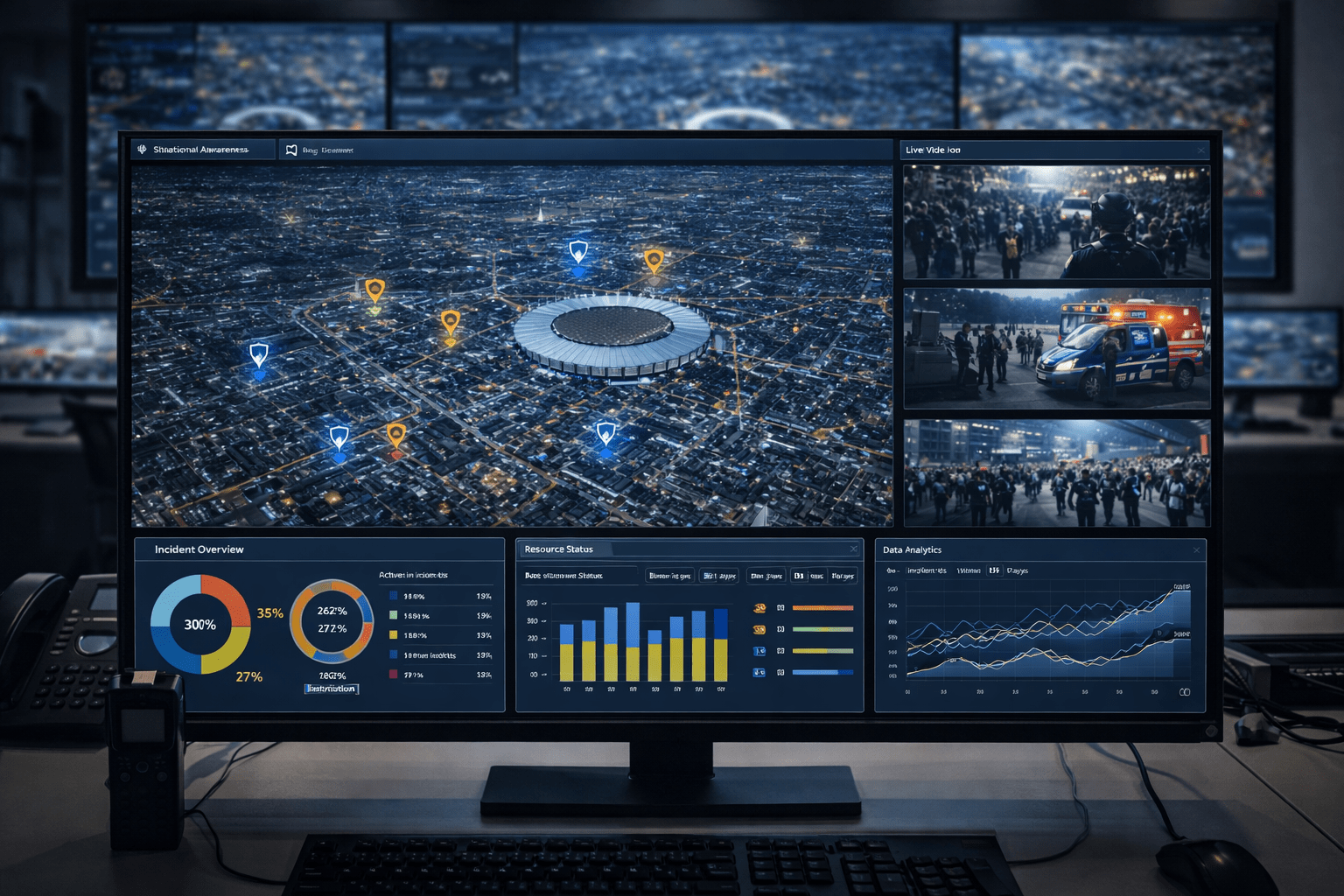
A C4I Integrated Control Center for Mega Events enables real-time monitoring and rapid response.
Data from multiple systems is consolidated into dashboards, providing a comprehensive operational picture.
This allows decision-makers to act quickly, reduce risks, and maintain control over event operations.
Security and Emergency Response Integration
Security and emergency coordination are critical components of a C4I Integrated Control Center for Mega Events.
An integrated command and control center enables collaboration between all stakeholders.
This ensures faster response times, improved coordination, and effective incident management.
Shared Incident Management Framework
A defining feature of a mature control center is the presence of a single, shared incident management framework that all stakeholders follow...
Where appropriate, aligning procedures with recognized guidance such as ISO 22320...
Challenges in Mega Event Operations Management
Mega events involve complex logistics, large crowds, and high security risks.
A C4I Integrated Control Center for Mega Events helps overcome these challenges through centralized coordination and real-time decision-making.
Maintaining clear communication across multiple stakeholders is one of the most significant challenges. Without standardized processes, information can become fragmented, leading to delayed or inconsistent responses.
In addition, the volume of data generated during mega events can overwhelm decision-makers. Control centers must filter and prioritize critical information to ensure effective situational awareness.
Future Trends in Integrated Command and Control Centers
Emerging technologies such as AI, IoT, and predictive analytics are transforming control center capabilities.
These innovations enhance efficiency, scalability, and responsiveness in managing large-scale events.
Cloud-based platforms and AI-driven analytics are enabling more predictive and scalable control center operations.
Governance and Command Structure for Mega Events
Every successful control center begins with governance. Before software selection, staffing, or procedures are discussed, the strategic framework must be defined. Mega events often involve multiple authorities with overlapping responsibilities, so clarity of authority is essential. Governance defines who has decision rights, under what conditions, and how escalation is triggered. It also defines how the control center interfaces with emergency services, venue operators, national authorities, and private contractors.
A formal Concept of Operations (ConOps) usually anchors this governance. It defines mission, scope, operating modes, command philosophy, and the transition logic from routine operations into incident or emergency management. A practical ConOps removes ambiguity when time is short and pressure is high.
Governance defines who has decision rights, under what conditions, and how escalation is triggered, supported by clearly defined incident management frameworks.
Scalable Organizational Structure for Control Centers
A control center for a mega event must be able to expand and contract without losing discipline. Routine days may run with a lean team, while peak days or incidents may require a surge capability with additional operators, liaison roles, and command functions. The structure should reflect that reality and avoid dependence on individual personalities.
Role definition is a major readiness multiplier. Operators, supervisors, duty managers, liaison officers, technical specialists, and command representatives must each understand their responsibilities, limits, and handover requirements. Documented role profiles and responsibility matrices improve continuity across 24/7 operations and help surge staff integrate quickly without friction.
All-Hazards Risk Management for Mega Events
Mega events operate under a constantly evolving risk profile. Crowd density, weather conditions, program schedules, transport load, and external threat intelligence can change hour by hour. A control center should operate on an all-hazards basis rather than focusing on isolated scenarios.
An integrated risk register allows safety, security, medical, technical, environmental, and reputational risks to be assessed using a common method. This helps leadership compare risks consistently, prioritize mitigations, and allocate resources based on impact rather than departmental bias. Scenario planning then turns risk analysis into practical readiness. Credible scenarios, including worst-case but plausible conditions, should drive tabletop exercises, functional drills, and integrated testing before live operations begin.
Operational Discipline and Standard Procedures
Mega events are not defined solely by major incidents. Most control center work happens during routine operations, and the quality of those routines determines how stable the organization is when pressure rises. Monitoring, alarm handling, access oversight, communications, reporting, and daily situation assessments must be consistent, auditable, and disciplined.
A dedicated routine operations manual helps operators perform consistently during quiet periods and prevents drift into complacency. It should be clearly separated from incident response procedures so teams do not confuse routine tasks with emergency actions when seconds matter.
Communications and Information Management
Communications are the nervous system of a C4I environment. Voice, data, alerts, and reports must flow reliably between the control center, field teams, leadership, and external agencies. Beyond channels and talk groups, what matters most is information discipline: what gets verified, how it gets logged, and how it is escalated without distortion.
Strong information management supports a Common Operational Picture and creates accountability. It also reduces the risk of misinformation in high-visibility environments where reputational damage can escalate as quickly as operational issues.
Intelligence and Predictive Monitoring
Modern control centers rely on more than reactive monitoring. Intelligence functions aggregate inputs from sensors, operational reporting, weather services, transport systems, and human observation to detect early warning signals. Daily situation assessments synthesize this information into decision-ready products, while trend analysis highlights systemic issues before they become incidents.
Documented intelligence processes are important for consistency, ethics, and appropriate sharing, especially when public confidence and political scrutiny are high.
Crowd and Mobility Management Integration
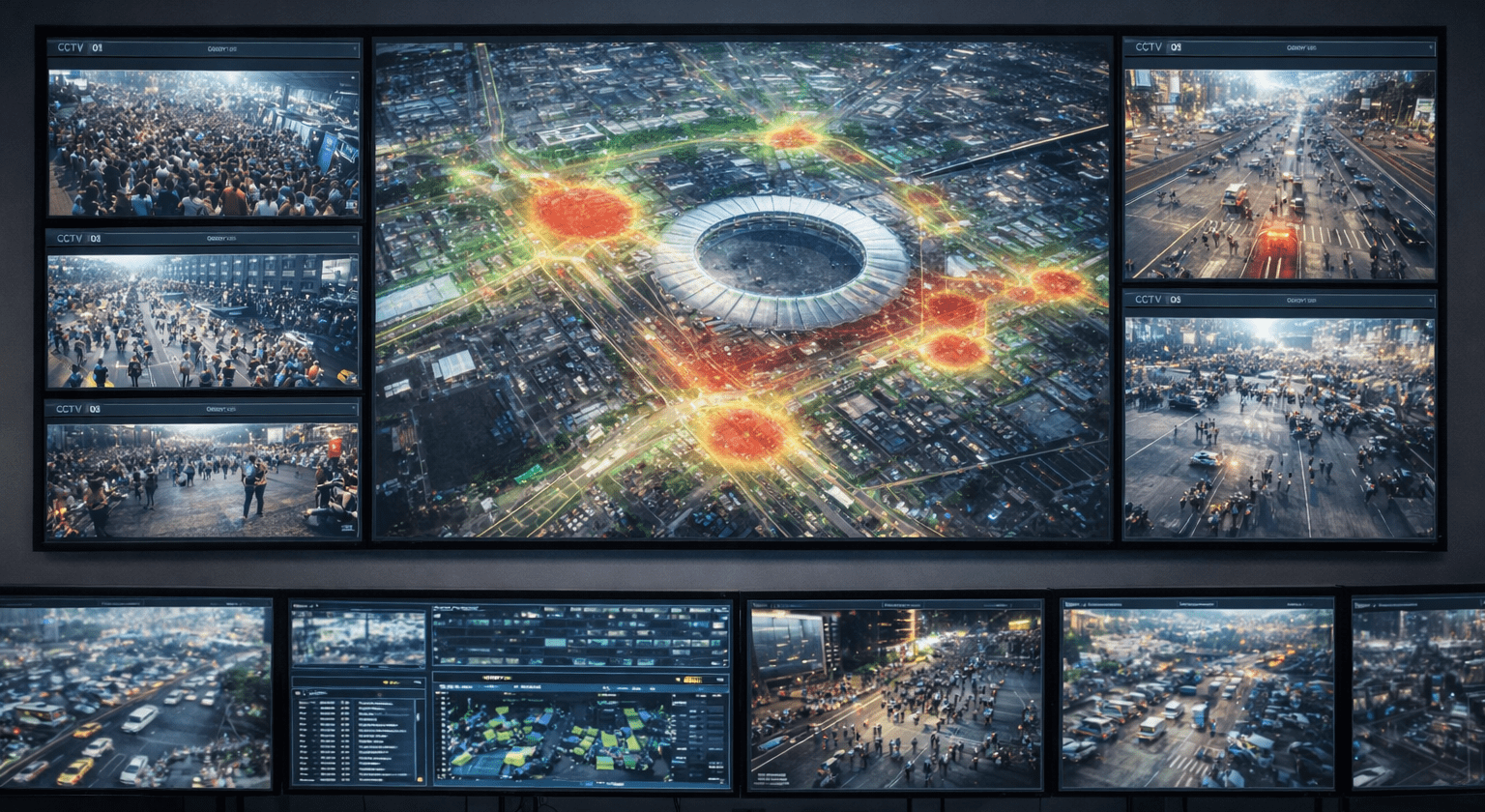
Crowd dynamics represent one of the most critical risk domains in mega events. The control center should maintain continuous awareness of density, flow, choke points, and the impact of transport conditions on entry and exit. Effective plans define thresholds and interventions that can be executed quickly and consistently, and they must connect tightly with venue operations and external transport coordination.
Including accessibility needs and welfare considerations strengthens resilience and public confidence. These details matter in public-facing operations where perception and safety are inseparable.
Post-Event Demobilization and Knowledge Transfer
The responsibilities of a control center do not end when the final visitor leaves. Demobilization must be controlled to ensure safe stand-down, orderly transition, and clean closure of outstanding issues. Final reports, data archiving, and lessons learned preserve institutional knowledge and improve future events. In some cases, the capability transitions into long-term operations, making post-event planning even more important.