
Expert Project Management and Security Operations Services
Integrated Control Center Standard Operating Procedures
Closing the gap between technology and human error through structured clarity and verifiable accountability.
Stop relying on "casual conversations." I build audit-ready SOP frameworks that eliminate operational gaps, ensure compliance, and protect your assets through verifiable accountability.
The Foundation of Operational Excellence
Across the Middle East’s most demanding residential and commercial environments, technology alone is not a security strategy. Professional Integrated Control Center Standard Operating Procedures are what bridge the gap between sophisticated hardware and human execution.
Standardized Operational Management
I establish the daily Standard Operating Procedures—from shift handovers to logbook integrity—ensuring a baseline of consistent, 24/7 management that eliminates reliance on casual conversation.
ISO 18788 & Regional Compliance
My SOP frameworks ensure your operations align with ISO 18788 and regional regulatory requirements, providing a legally sound, verifiable, and audit-ready environment.
Continuous Operational Oversight
I build the internal audit and verification mechanisms required to ensure your SOPs are being followed. This creates a transparent trail of accountability that survives personnel changes and shift rotations.
Looking for emergency handling? View my Integrated Response Procedures.
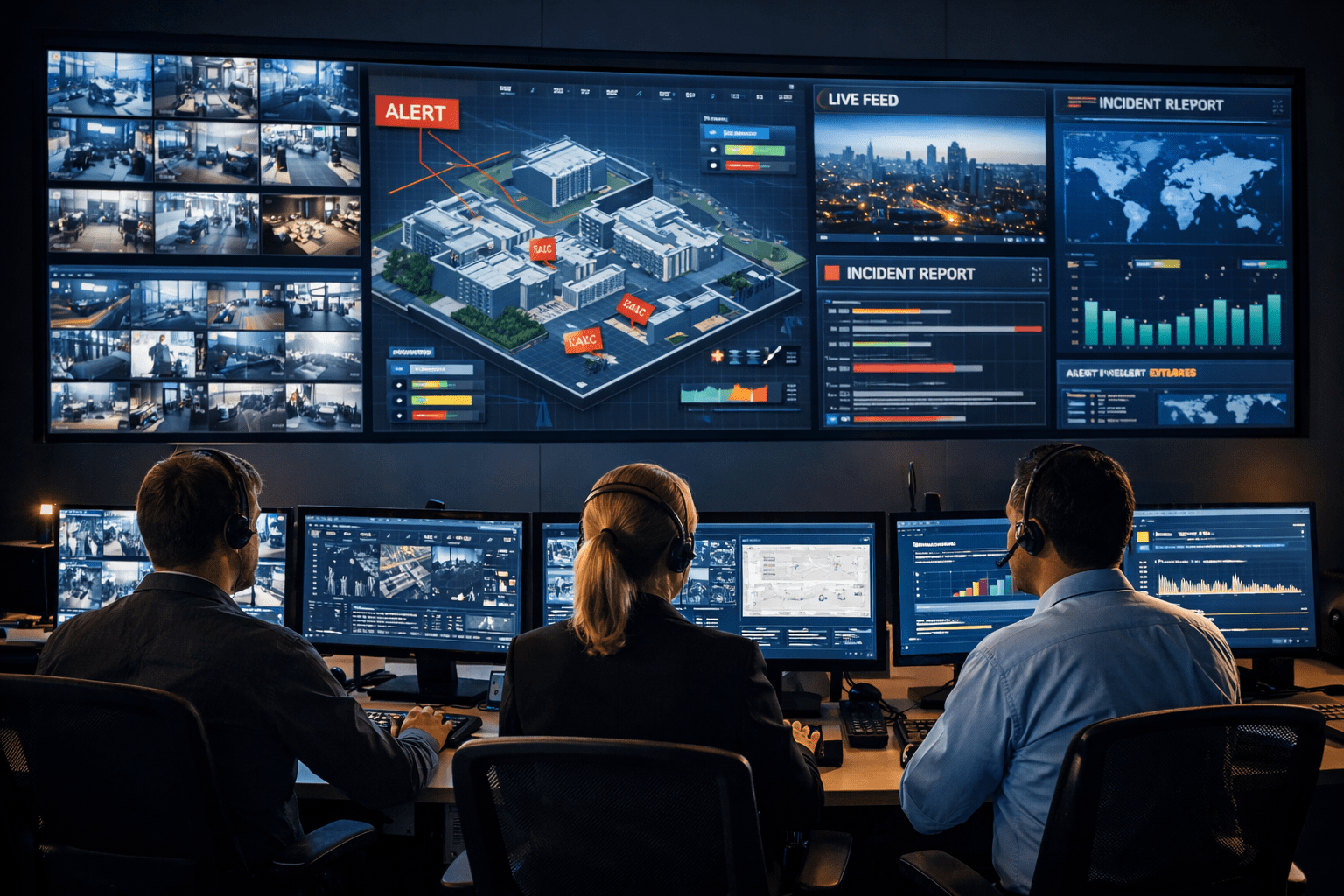
The Purpose of Control Room Standard Operating Procedures
Control room standard operating procedures define how routine control room activities are to be performed during normal operations. Their purpose is to ensure that monitoring, coordination, communications, reporting, and supervision are carried out in a consistent, disciplined, and repeatable manner across all shifts.
In an integrated environment, SOPs do more than document routine tasks. They establish the operational baseline for how personnel manage access control support, surveillance, visitor and delivery coordination, system status checks, logging, and day-to-day communications. This reduces ambiguity, supports continuity, and ensures that the control room operates to a common standard rather than personal habit or shift-based variation.
SOPs also support auditability, supervision, and continuous improvement. When routine activities are clearly defined and consistently applied, control room performance becomes easier to review, measure, and strengthen over time.
SOPs vs Response Procedures in an Integrated Control Center
I ntegrated control centers rely on two different procedural layers: standard operating procedures for routine operations, and response procedures for incidents, emergencies, and other non-routine situations.
Integrated Control Center Standard Operating Procedures apply during normal conditions. They govern day-to-day control room operations such as monitoring, communications, reporting, shift handover, access control support, and routine coordination with site personnel and service functions.
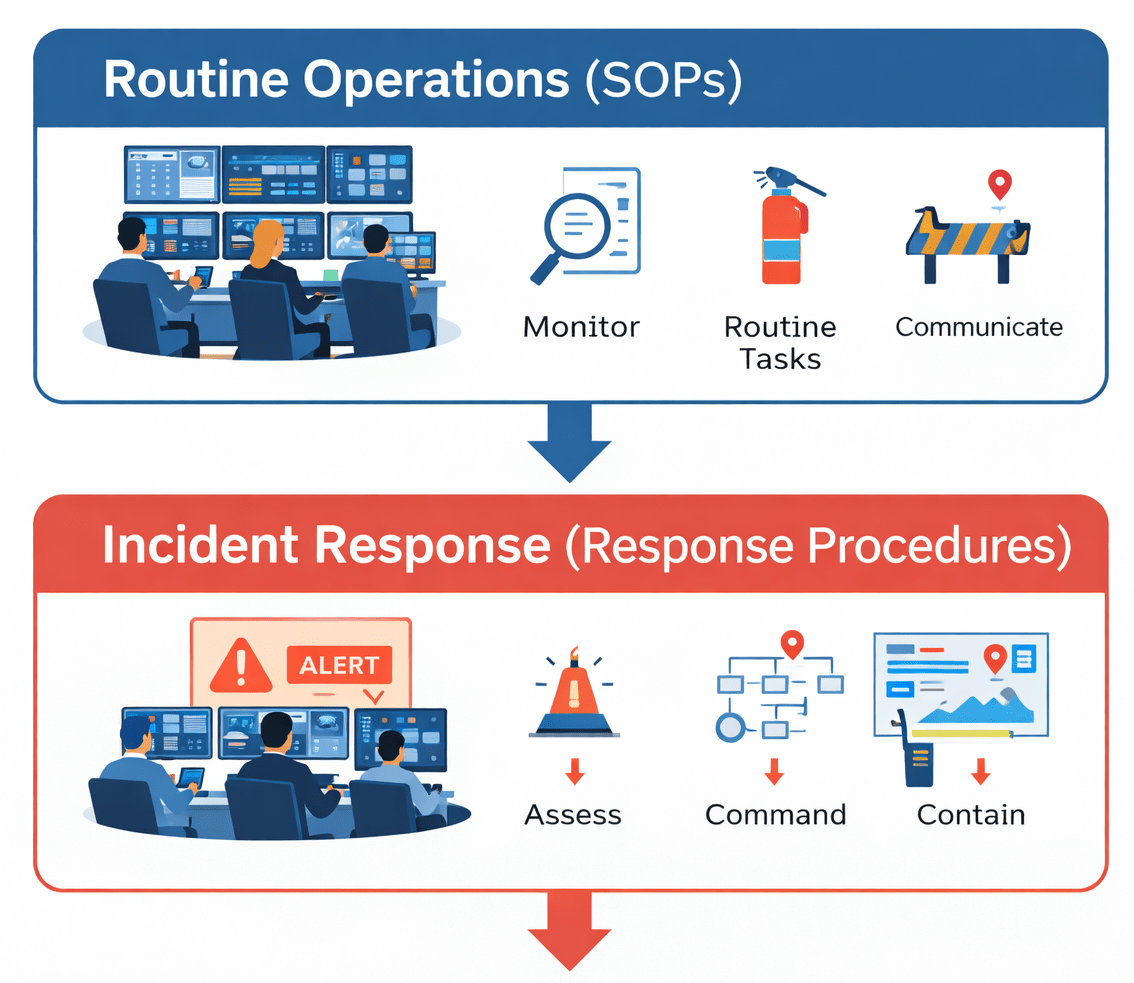
Response procedures apply when an unwanted situation has been identified and a structured response is required. In those circumstances, the control room continues to perform important support functions, but the operational objective shifts from routine control to incident support, escalation, coordination, and documentation in line with the relevant response procedures for integrated control centers.
This distinction matters operationally. SOPs are designed to maintain order, readiness, and consistency during business-as-usual activities, while response procedures are designed to guide action under abnormal or time-critical conditions. Keeping that boundary clear helps prevent confusion, role overlap, and procedural drift.
In integrated control center environments, it is important to clearly distinguish between standard operating procedures and response procedures. While both are essential, they serve different operational purposes.
The distinction between these two procedural layers can be summarized as follows:
Key Operational Differences
| Aspect | Standard Operating Procedures (SOPs) | Response Procedures |
|---|---|---|
| Primary Purpose | Ensure consistent and controlled execution of routine operations | Guide structured response to incidents and emergencies |
| Operational Context | Routine, day-to-day control room operations under normal conditions | Unplanned events, incidents, or emergencies requiring structured response |
| Focus | Consistency, discipline, monitoring, and coordination | Escalation, decision-making, and incident management |
| Examples | Shift handover, logging, access control support, routine communications | Fire response, security breach, medical emergency, system failure response |
| Authority | Defined by operational SOP framework | Defined by incident response plans and procedures |
| Operational Role | Maintain control and readiness | Manage and resolve incidents |
In practice, both procedural layers are interdependent. Strong execution of SOPs ensures that the control room maintains situational awareness, operational discipline, and accurate records—conditions that are essential for effective incident response when response procedures are activated.
International standards such as ISO 22320 – Emergency Management Guidelines for Incident Management reinforce the importance of structured response frameworks and clear command relationships during incident situations.
Scope and Applicability of SOPs in Day-to-Day Control Room Operations
Integrated Control Center Standard Operating Procedures apply to all personnel assigned to control room duties, including operators, dispatchers, supervisors, and any supporting roles involved in monitoring or coordination activities. They apply consistently across all shifts and operating conditions classified as normal or business-as-usual.
These procedures govern day-to-day control room operations, including system monitoring, alarm handling, access control support, communications, reporting, logging, and coordination with site teams and service providers. Their purpose is to ensure that routine activities are performed in a controlled and standardized manner regardless of who is on duty.
SOPs apply until an event is formally identified and classified as an incident or emergency. At that point, response procedures take precedence. The control center continues to operate, but its role shifts from routine supervision to structured support, coordination, and documentation in alignment with the activated response procedure.
Operating States and SOP Application
Integrated control centers typically operate under defined operating states to maintain clarity of posture, responsibilities, and decision-making authority. These states help distinguish between routine operations and situations requiring structured response.
Normal Operations
During normal operations, control room standard operating procedures fully govern all activities. This includes monitoring, communications, reporting, access control support, and routine coordination. The objective is to maintain stability, situational awareness, and consistent execution of day-to-day control room operations.
Heightened Awareness
Heightened awareness may be declared due to increased risk, planned events, system degradation, or external factors. SOPs remain in effect, but with increased vigilance, more frequent reporting, and closer supervision of critical systems and activities.
Incident Support Mode
When an incident or emergency is formally declared, the control room transitions into incident support mode. At this point, response procedures take precedence for managing the situation.
Roles, Responsibilities, and Duty Assignments
Integrated control room SOPs must define responsibilities clearly so that every routine task has an accountable owner. This is essential for operational consistency, effective supervision, and reliable shift performance.
Shift Supervisors retain overall responsibility for control room operations during their assigned shift. This includes oversight of operator performance, workload allocation, communications discipline, escalation decisions within routine authority, and confirmation that logs, reports, and handovers are completed to standard.
Control Room Operators are responsible for continuous monitoring, alarm handling, CCTV surveillance, routine coordination, logging, and system supervision in accordance with approved procedures. Where applicable, dispatchers or call-takers manage structured telephone and radio communications, message handling, and coordination with mobile teams, reception points, or service providers.
Only trained, authorized, and rostered personnel should perform control room duties. Temporary coverage, informal task substitution, or unapproved console use should not be permitted, as these introduce avoidable operational risk and weaken procedural control.
Core Day-to-Day Control Room Operations Covered by SOPs
Standard operating procedures typically define the routine activities required to maintain effective control room operations under normal conditions. While the exact scope will vary depending on the operational environment, systems, and organizational structure, most integrated control centers rely on a common set of core functions to support day-to-day control room operations, including the following:
Monitoring, Alarm Handling, and Surveillance
SOPs generally describe how operators monitor live systems, review alarms, verify events, and manage CCTV or other surveillance platforms. This usually includes prioritization rules, acknowledgement requirements, verification steps, and conditions for escalation when abnormal activity is detected.
Access Control Support
In many environments, the control room supports routine access control activities such as remote door release, badge status checks, after-hours access validation, and coordination with on-site personnel. The level of involvement may vary depending on how access control responsibilities are distributed.
Visitor and Delivery Coordination
Where applicable, SOPs may address how the control room supports visitor arrivals, contractor access, and delivery management. This can include identity confirmation, communication with hosting departments, routing coordination, delivery bookings and coordination, and logging of exceptions or issues.
Routine Communications and Coordination
Control room personnel typically coordinate with guards, reception teams, maintenance staff, facility teams, and other operational functions. SOPs define approved communication channels, message structure, logging expectations, and communication priorities for routine activities.
Logging, Reporting, and Record Control
Routine actions, observations, system faults, and significant communications are generally recorded in accordance with defined logging standards. SOPs clarify what must be recorded, when entries are required, and how records support oversight, auditability, and shift continuity.
System Health Checks and Operational Assurance
Most control rooms include routine verification of system availability and performance as part of normal operations. SOPs may define periodic checks, fault reporting processes, compensatory measures, and notification requirements when systems or services are degraded.
Typical SOP Workflow in an Integrated Control Center
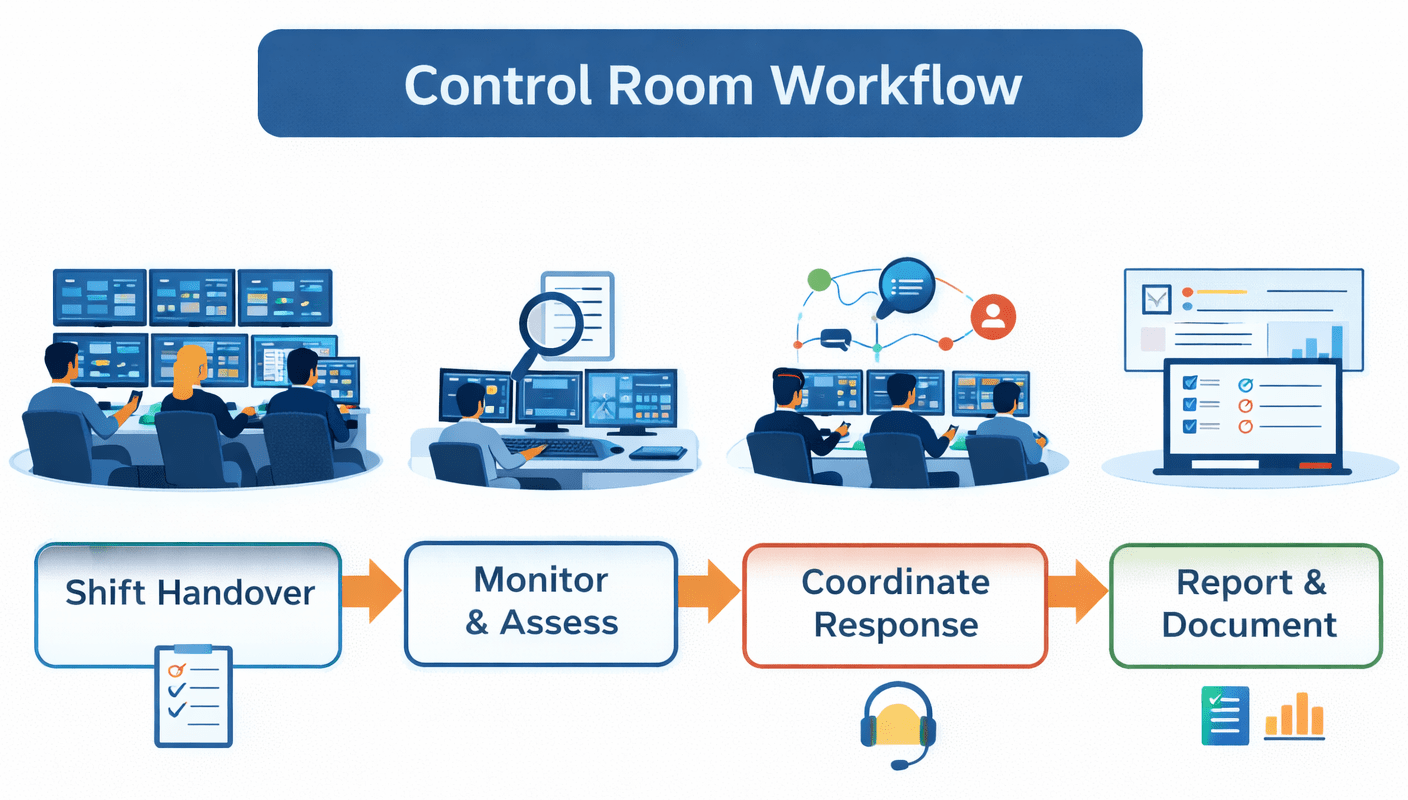
This is not a prescriptive sequence, but a typical representation of how SOPs structure routine operations in many integrated control room environments.
While specific procedures vary by organization, most integrated control centers follow a broadly similar operational flow during routine conditions. This workflow reflects how SOPs are applied throughout a typical shift.
Shift Start and Handover
The incoming team receives a structured briefing, reviews system status, checks logs, and confirms readiness before assuming responsibility.
Establishing Operational Awareness
Operators confirm system availability, review outstanding issues, assess current conditions, and ensure that monitoring and communications channels are fully operational.
Routine Monitoring and Coordination
During the shift, operators perform continuous monitoring, alarm handling, access control support, communications, and coordination with site teams in accordance with SOPs.
Ongoing Logging and Reporting
All relevant activities, observations, and communications are recorded in real time, ensuring a reliable operational record and supporting shift continuity.
Managing Changes and Emerging Issues
Operators identify and track unusual activity, system faults, or developing risks. Where required, these are escalated in line with defined thresholds or managed within routine operations.
Shift Close and Handover Preparation
Before the end of the shift, logs are updated, outstanding issues are clearly documented, and the control room prepares for structured handover to the incoming team.
Example Structure of a Control Room SOP
While formats vary between organizations, most control room standard operating procedures follow a structured and repeatable format. The objective is to ensure clarity, consistency, and ease of use during routine operations.
A simplified SOP structure may include the following elements:
- Purpose: Defines the objective of the procedure and what it is intended to control or achieve
- Scope: Identifies where and when the procedure applies
- Responsibilities: Specifies which roles are responsible for performing or supervising the task
- Procedure Steps: Provides a clear, step-by-step description of how the task is performed
- Communications Requirements: Defines who must be informed and how communication is handled
- Recording and Reporting: Specifies what must be logged or documented
- Exceptions and Escalation: Defines how unusual situations or deviations are handled
This type of structure helps ensure that procedures remain practical, usable, and consistent across different operators and shifts, while still allowing adaptation to site-specific requirements.
Example: Routine Access Control Procedure (Simplified)
The following example illustrates how a routine control room SOP might be structured in practice. This is a simplified example for illustration purposes and does not represent a complete operational procedure.
Purpose
To ensure that after-hours access requests are verified, authorized, and recorded in a controlled and consistent manner.
Process Overview
- Receive access request via approved communication channel (e.g. phone, intercom, or system alert).
- Verify identity of the requester using approved identification methods.
- Confirm access authorization against approved access lists or designated authority.
- If authorization is confirmed, grant access using the appropriate system or by coordinating with on-site personnel.
- If authorization cannot be confirmed, deny access and escalate in accordance with defined instructions.
- Record the request, verification outcome, and action taken in the control room log.
Recording Requirements
All access requests, whether approved or denied, should be logged with time, identity (where available), action taken, and any relevant remarks.
Exceptions
Unusual requests, repeated access issues, or discrepancies in authorization should be reported to the supervisor and handled in accordance with escalation guidelines.
Control Room Shift Handover Procedure
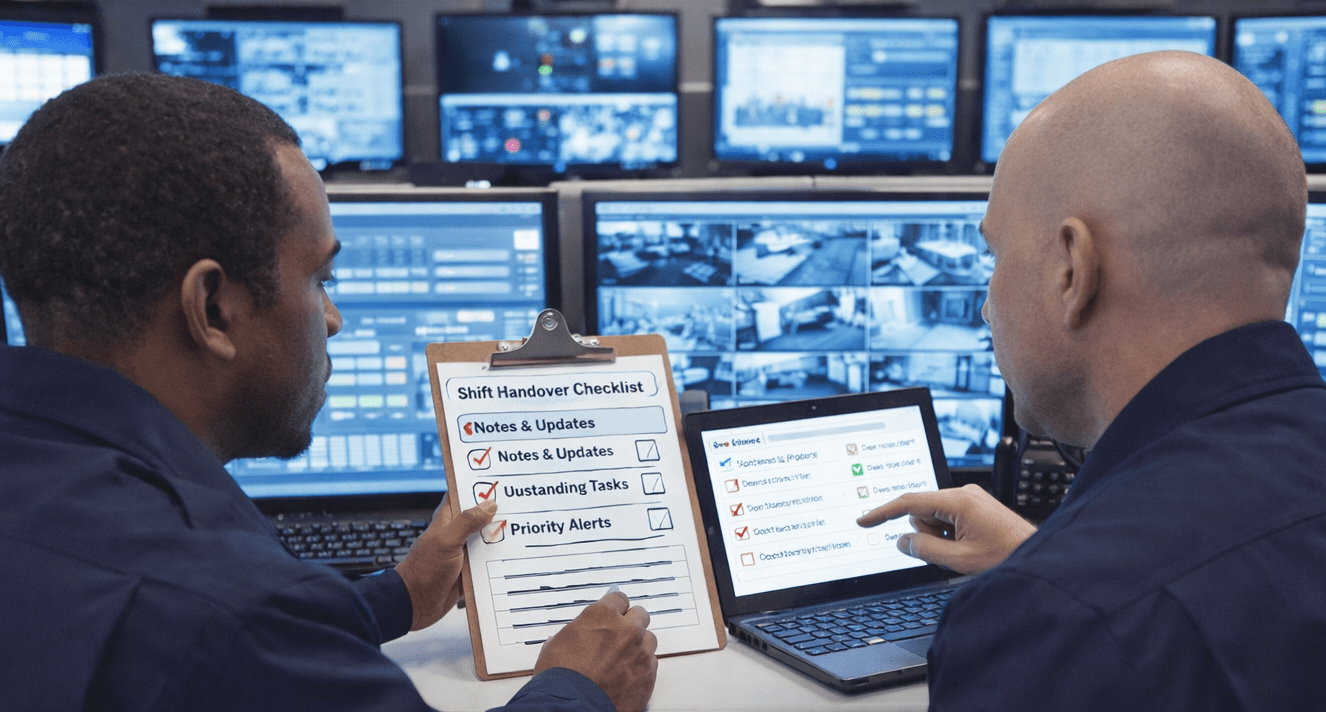
A structured control room shift handover procedure is critical to maintaining continuity between outgoing and incoming teams. It ensures that operational awareness, system status, and ongoing activities are clearly understood before responsibility is transferred.
Handover should not be treated as a routine formality. It is a controlled process that directly impacts situational awareness, decision-making, and the ability of the incoming shift to operate effectively from the moment they assume responsibility.
Handover Content
The outgoing team should provide a clear and structured briefing covering key operational elements. While the exact format may vary, typical handover content includes:
- Current operational status and overall security or facility posture
- System health, faults, or degraded capabilities
- Ongoing events, alarms, or incidents, including their current status, actions taken, and actions still required
- Access control exceptions, visitor or contractor presence, and special conditions
- Ongoing coordination with site teams, service providers, or external parties
- Known risks, constraints, or areas requiring attention
Particular attention should be given to ongoing events or situations that require follow-up actions. The incoming shift must clearly understand what has already been done, what decisions have been taken, and what actions are still pending to avoid duplication, delay, or loss of control.
Verification and Responsibility Transfer
Incoming personnel should verify system status, review logs, and confirm their understanding of the current situation before accepting responsibility. This may include checking critical systems, validating open tasks, and clarifying any uncertainties with the outgoing team.
Responsibility should only transfer once the incoming shift formally confirms readiness. This avoids gaps in coverage and reduces the risk of missed information or incorrect assumptions.
Consistency and Documentation
SOPs should define how handovers are conducted, whether through structured checklists, log entries, or formal briefing formats. Consistency is essential to ensure that no critical information is omitted and that handover quality does not depend on individual practice.
Control Room Communications Discipline
The control room functions as a central communications point for routine coordination, status updates, and operational support. SOPs should define how radio, telephone, and internal communications are handled so that information is transmitted clearly, consistently, and without unnecessary delay.
Communications discipline is essential in both normal operations and periods of increased activity. Messages should be concise, relevant, and structured in a way that reduces misunderstanding. Use of approved call signs, standard terminology, read-back where appropriate, and clear priority handling all help maintain control of the operating environment.
Routine Communications Requirements
Depending on the control room environment, routine communications may include coordination with guards, reception, maintenance teams, facility staff, transport functions, supervisors, and external service providers. SOPs should define approved channels, expected communication standards, and when significant messages must be logged or escalated.
Priority and Message Control
Not all communications carry the same importance. SOPs should distinguish between routine traffic, priority messages, and communications that require immediate supervisory awareness. This helps prevent critical information from being delayed, overlooked, or lost within routine traffic.
Recording Significant Communications
Significant operational communications should be recorded accurately and in a timely manner. This includes important instructions, unusual observations, access-related exceptions, fault notifications, and other messages that may affect operations, accountability, or later review.
Situation Awareness, Monitoring, and Reporting
Maintaining situational awareness is a core function of day-to-day control room operations. SOPs should define how operators and supervisors maintain an accurate understanding of current conditions, including security posture, safety-related information, system availability, access issues, and other operational factors that may affect the site.
This is not limited to watching screens or reacting to alarms. Effective situation awareness also depends on structured review, active monitoring, information sharing, and clear recognition of changes that may require closer attention or escalation.
Structured Situation Review
At defined intervals, and typically at least once per shift, the control room should conduct a structured review of current conditions. Depending on the environment, this may include system health, outstanding faults, unusual activity, staffing impacts, restricted areas, weather-related factors, or other issues relevant to ongoing operations.
Monitoring for Changes and Emerging Risks
SOPs should support active recognition of changes that could affect routine operations, even where no incident has been declared. This may include repeated nuisance alarms, degraded systems, unusual access patterns, communications issues, or developing conditions that warrant increased awareness or supervisory review.
Shift Reporting and Operational Record
Formal shift reports should document operational status, notable events, unresolved issues, degraded capabilities, and any matters requiring follow-up by the next shift or by management. These reports support continuity, oversight, accountability, and longer-term operational improvement.
Readiness and Preparedness in Control Room Operations
Maintaining readiness is a continuous requirement in an integrated control center. SOPs should ensure that personnel, systems, and processes remain prepared to support operations under both normal and degraded conditions without loss of control or situational awareness.
Readiness is not only about responding to incidents. It is built through consistent execution of day-to-day control room operations, where discipline, familiarity with procedures, and operational awareness are maintained across all shifts.
Personnel Readiness
Control room personnel should be fit for duty, properly trained, and familiar with applicable procedures, systems, and responsibilities. This includes maintaining awareness of current conditions, understanding ongoing activities, and being able to assume responsibilities without delay.
System and Operational Readiness
SOPs should support early identification of degraded systems, communication issues, or operational constraints. Where limitations exist, compensatory measures and clear communication should be applied to maintain operational continuity.
Preparedness for Transition
Effective SOP execution ensures that the control room can transition smoothly into incident support when required. When routine operations are controlled, documented, and well understood, the shift from normal operations to response procedures becomes structured, deliberate, and unambiguous.
Frameworks such as ISO 31000 – Risk Management Guidelines emphasize the importance of structured processes, continuous assessment, and alignment between operational practices and risk conditions.
Why Control Room SOPs Fail in Practice
In many control room environments, standard operating procedures exist but are not consistently applied or do not achieve their intended purpose. This is rarely due to the concept of SOPs themselves, but rather how they are developed, implemented, and maintained.
Lack of Operational Alignment
SOPs that are written without reflecting actual control room workflows often become impractical. If procedures do not match how systems, personnel, and responsibilities are structured, they are likely to be bypassed or inconsistently applied.
Overly Theoretical or Complex Documentation
Procedures that are too detailed, overly complex, or written in non-operational language can be difficult to use in real-time environments. Control room personnel require clear, concise, and usable instructions that support quick understanding and consistent execution.
Inconsistent Application Across Shifts
Without strong supervision and reinforcement, different shifts may develop their own working practices. This leads to variation in how tasks are performed, reducing predictability and increasing the risk of errors or missed actions.
Poor Integration with Systems and Tools
SOPs that are not aligned with actual systems, interfaces, or workflows (such as CCTV platforms, access control systems, or PSIM tools) can create friction and reduce compliance.
Limited Review and Continuous Improvement
Operational environments evolve, but SOPs are often left unchanged. Without periodic review, procedures may become outdated, misaligned with current risks, or inconsistent with system changes.
Addressing these challenges requires a practical, operations-driven approach to SOP development, supported by supervision, training, and continuous refinement.
Operational Maturity in Control Room SOPs
Control room SOPs can vary significantly in quality and effectiveness depending on how they are developed, implemented, and maintained. In practice, organizations tend to operate at different levels of procedural maturity.
Basic
Procedures exist but are incomplete, inconsistently applied, or not aligned with actual operations. Execution depends heavily on individual experience rather than structured guidance.
Defined
SOPs are documented and cover key activities, but application may still vary between shifts or individuals. Supervision and enforcement are present but not fully consistent.
Controlled
Procedures are clearly defined, aligned with systems and workflows, and consistently applied. Performance is monitored, and deviations are identified and addressed.
Optimized
SOPs are continuously reviewed and improved based on operational feedback, incident analysis, and system changes. The control room operates with high consistency, strong situational awareness, and clear accountability.
Understanding this progression helps organizations identify gaps and prioritize improvements in their control room operations.